
Best Lawn Fertilization Wesley Chapel-4-Week Green Guarantee
If your grass looks yellow, thin, or patchy, there are real reasons for it. And fertilization done right can fix it faster than you’d think.
Mail to: hello@greenlawncarewesleychapel.com
100+ ReviewS
Licensed & Certified
100% Satisfied clients
If your lawn in Wesley Chapel is turning yellow, thinning out, or growing more weeds than grass, you’re not doing anything wrong. This is just what Florida does to lawns that aren’t fed properly.
The soil out here in Pasco County is notoriously sandy. It drains fast, which sounds nice until you realize it drains nutrients just as fast. Every time we get one of those heavy summer downpours — and we get a lot of them — nitrogen, iron, and other essential minerals wash right past the root zone and disappear into the ground.
That’s not a homeowner problem. That’s a Florida soil problem. And the fix is a consistent, properly-timed fertilization schedule built around how this climate actually behaves.
The short answer: Most Wesley Chapel lawns need fertilization 4–6 times per year, using the right nutrient blend at the right time — not a generic bag from a big-box store applied whenever it’s convenient.
Why Lawns Struggle in Wesley Chapel, Specifically
It’s not just the sandy soil. A few things are working against you here that you wouldn’t deal with in, say, the Carolinas or Tennessee.
The Soil Has No Memory
Sandy soil is essentially nutrient-blind. It doesn’t hold onto fertilizer the way clay or loam does in other parts of the country. You apply it, and within a week or two — especially after rain — a big chunk of it is gone. That’s why you’ll see lawns here go from looking decent to looking stressed surprisingly fast.
The Rainy Season Washes Everything Out
From June through September, Wesley Chapel averages close to seven inches of rain per month. That’s a lot of water moving through sandy soil. Nitrogen — the nutrient most responsible for that deep green color — is water-soluble. Heavy rain and nitrogen don’t get along well.
The Heat Accelerates Everything
Florida’s heat doesn’t just stress your lawn — it accelerates the entire nutrient cycle. Grass grows faster in heat, burns through nitrogen faster, and weeds thrive in the exact conditions where a nutrient-depleted lawn can’t compete. The combination of heat and low fertility is a welcome mat for dollarweed, crabgrass, and sedge.
Irrigation Habits Make It Worse
Many homeowners (and HOA irrigation systems) water too frequently and too shallowly. This keeps moisture near the surface and encourages shallow root systems. Shallow roots can’t access nutrients deeper in the soil, and they’re the first to suffer when temperatures spike above 90°F — which happens here regularly from May through October.
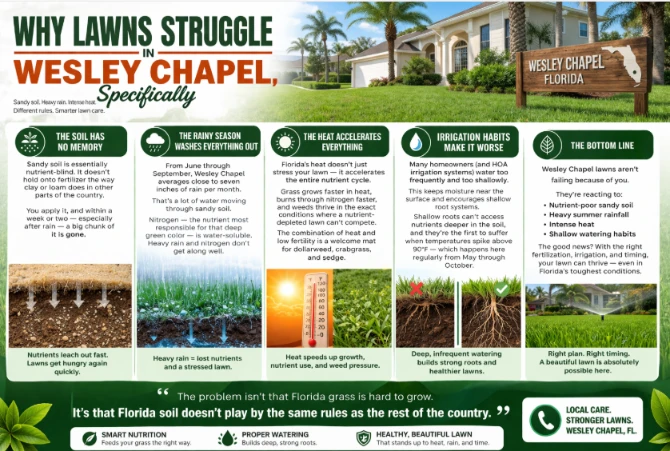
“The problem isn’t that Florida grass is hard to grow. It’s that Florida soil doesn’t play by the same rules as the rest of the country.“
What Proper Lawn Fertilization Wesley Chapel Actually Does
A professional fertilization program isn’t just spreading granules and hoping for the best. It’s about matching what your specific grass type needs, at the right time of year, in amounts the soil can actually hold on to.
Most Wesley Chapel lawns are St. Augustine grass — specifically Floratam — with some Zoysia and Bahia mixed in, depending on the neighborhood. Each of these has different nutrient requirements and responds differently to timing. That matters a lot.
The Right Nutrients at the Right Ratios
For Florida lawns, nitrogen is the primary driver of color and growth. But it needs to be balanced with potassium (for root strength and drought resistance) and iron (for color without excessive growth during summer). A high-nitrogen blend applied in August, for example, can actually damage your lawn by pushing soft new growth right before fall — growth that becomes disease-prone quickly in our humidity.
Slow-Release vs. Fast-Release
This is one of the most overlooked decisions in lawn care. Fast-release fertilizers give you a quick green pop but flush out of sandy soil within weeks. Slow-release formulas — polymer-coated or sulfur-coated urea — release gradually, which means the grass actually gets to use them. For our soil type, slow-release blends make a huge difference in how long the results last between applications.
What You’ll See, and When
Week 1–2
Color starts deepening. Yellow areas begin to fade.
Week 3–4
Density improves. Thin patches fill in noticeably.
Week 6–8
Weeds decline as thick grass crowds them out naturally.
Ongoing
A consistent program maintains health through seasonal shifts.
Simple Plans for a
Greener Wesley Chapel Lawn
No contracts. No surprises. Every program is built around your grass type, your neighborhood, and Pasco County’s fertilizer ordinance — so you’re always compliant and always getting results.
- ✓Visual lawn & soil assessment
- ✓Slow-release nitrogen + iron blend
- ✓St. Augustine, Zoysia & Bahia ready
- ✓Pasco County ordinance compliant
- ✓Same-day application report (email)
- ✓4-Week Green Guarantee included
- ✓Custom schedule for your grass type
- ✓Rainy season smart timing (June–Sept)
- ✓Mid-season check-in call
- ✓Free re-treatment if no visible result
- ✓Weed pressure monitoring each visit
- ✓HOA-ready documentation on request
- ✓Spring startup + winter wind-down
- ✓Iron-only winter visits (no frost damage)
- ✓Annual soil health report
- ✓Priority same-week scheduling
- ✓10% off all add-on services
- ✓Free fungicide visit if disease detected
Exact pricing confirmed during your free lawn assessment — no obligation, we come to you.
Best Fertilization Timing in Florida
If there’s one thing that separates a good lawn care result from a great one, it’s timing. Fertilizing at the wrong time in Florida doesn’t just waste money — it can actually set your lawn back.
Season / Period | What to Apply | Why It Matters |
Early Spring (March–April) | Balanced NPK with slow-release nitrogen | Wakes up dormant grass, encourages root development before summer heat |
Late Spring (May–June) | Nitrogen + iron boost | Maximizes density before the rainy season begins; iron deepens color without excessive growth |
Midsummer (July–August) | Light potassium application, minimal nitrogen | Strengthens roots without pushing vulnerable growth during peak heat and humidity |
Early Fall (September–October | Slow-release balanced blend | Prepares grass for cooler temperatures; builds carbohydrate reserves |
Late Fall / Winter (Nov–Feb) | Low or no nitrogen; iron-only if needed | Dormant season — high nitrogen now can cause frost damage and disease |
Local note: Pasco County’s fertilizer ordinance restricts nitrogen and phosphorus applications during the rainy season (June 1 – September 30) to limit waterway runoff. A professional service will always stay compliant, which is another reason DIY timing can backfire legally, not just agronomically.
Common Mistakes Homeowners Make
Most lawn problems we see in Wesley Chapel aren’t from neglect — they’re from well-intentioned care done at the wrong time or with the wrong product. Here are the ones that come up over and over.
Fertilizing on a fixed calendar
Applying every 8 weeks regardless of weather or grass growth stage ignores what the lawn actually needs.
Using off-the-shelf big-box blends
National products aren’t formulated for Florida’s sandy soil or our specific warm-season grass types.
Fertilizing before heavy rain
Applying right before a storm means nutrients wash away before the grass can absorb them.
Over-fertilizing in summer heat
Too much nitrogen in July–August pushes soft growth that’s extremely vulnerable to fungal disease in our humidity.
Watering after every application
Granular slow-release fertilizer needs light watering in — but drenching it immediately flushes it past the root zone.
Skipping weed control integration
Fertilizing a weed-infested lawn feeds the weeds just as much as the grass. Pre-emergent timing matters.
Who This Service Is Built For
We work with all kinds of homeowners in Wesley Chapel, but a few types come to us most often.
BUSY HOMEOWNERS of Lawn Fertilization Wesley Chapel
You don’t have time to research fertilizer schedules and track county ordinances. You just want your lawn to look good. We handle all of it.
HOA RESIDENTS
In communities like Epperson, Wiregrass, or Seven Oaks, appearance standards are strict. A consistent program keeps you compliant and your neighbors impressed.
NEW TO FLORIDA
If you moved here from up North and your old lawn habits aren’t working, that makes complete sense. Florida grass is a completely different animal.
DIYERS WHO ARE DONE
You’ve tried a few products, maybe watched some YouTube videos, and the lawn still looks the same. Sometimes, the right answer is just having someone who does this every day take over.
🌿 Lawn Fertilization Smart Tool
Instant diagnosis + Talk to expert in seconds
Frequently Asked Questions
These are the questions we hear most from homeowners in Wesley Chapel and the surrounding areas.
Why is my lawn turning yellow in Wesley Chapel?
Yellow grass in Wesley Chapel is almost always a sign of nitrogen deficiency, iron deficiency, or both. Our sandy soil doesn’t hold nutrients well, and the heavy summer rain flushes them out quickly. In some cases, overwatering or a fungal issue can cause similar symptoms. A soil assessment helps identify the exact cause.
How often should I fertilize my lawn in Florida?
Most Florida lawns benefit from 4–6 fertilizer applications per year, spaced roughly 6–8 weeks apart during the growing season. Timing matters more than frequency — and local county ordinances restrict certain nutrients during the rainy season (June 1 through September 30).
What kind of fertilizer is best for St. Augustine grass in Wesley Chapel?
St. Augustine — specifically Floratam — responds best to a high-nitrogen, slow-release fertilizer with added iron. Look for formulas designed for warm-season Florida grasses, not generic all-purpose blends. Slow-release nitrogen matters in sandy soil because it reduces nutrient runoff and extends feeding time.
Can fertilizing my lawn help with weeds?
Yes — indirectly. A thick, healthy, well-fed lawn is the best defense against weeds. Dense grass physically crowds out weed seedlings and competes for the same resources. Fertilization alone won’t eliminate an existing weed problem, but combined with pre-emergent herbicide at the right time, it dramatically reduces weed pressure over a season or two.
When is the best time to fertilize in Wesley Chapel?
The most impactful applications are in early spring (March–April) when the grass is coming out of winter dormancy, and again in late spring (May–June) before the rainy season starts. Avoid heavy fertilization during the peak of summer heat and limit applications in winter when grass growth is minimal.
How long does it take to see results after lawn fertilization?
Most homeowners notice color improvement within 10–14 days of a proper application, especially with fast-release nitrogen included. Fuller density and patchy area improvement typically show clearly by weeks 3–4. Full results from a first-time program are usually visible within 6–8 weeks, depending on the condition of the lawn coming in.
Is professional lawn fertilization worth it compared to doing it myself?
For most homeowners in Wesley Chapel, yes. The county fertilizer ordinance, the specific soil conditions here, the need to time applications around weather patterns, and the importance of matching product type to grass type all add up. Getting it wrong — wrong product, wrong timing, wrong rate — can burn your lawn or waste money without results. A professional program removes all of that guesswork.
Areas we Serve
Based in Wesley Chapel — also covering: